
As someone who exercises regularly, let me be honest.
There are so many sports products on the market nowadays —
running shoes, leggings, sports tops, jackets, sports bras, watches, and many other accessories.
A lot of people often ask:
Do you really need to buy and wear professional sports gear to exercise?
To be honest, here is my real opinion.
After exercising for so many years, I’ve realized something:
Even though every part of my gear matters,
the two things I care about the most are running shoes and sports bras.
In the beginning, I didn’t really understand sports bras.
I didn’t pay much attention to them at all.
To me, they felt just like the simple bras my mom bought for me when I was in elementary school.
But that idea was completely wrong.
Studies have shown that 41% of women are wearing the wrong sports bra.
And I’m pretty sure I used to be one of them!
A proper sports bra provides protection during exercise.
It can also reduce the risk of breast tissue spreading outward or developing side boob due to wearing unsuitable bras during long-term exercise.
⸻
Sports Bras Are Designed for Different Levels of Activity
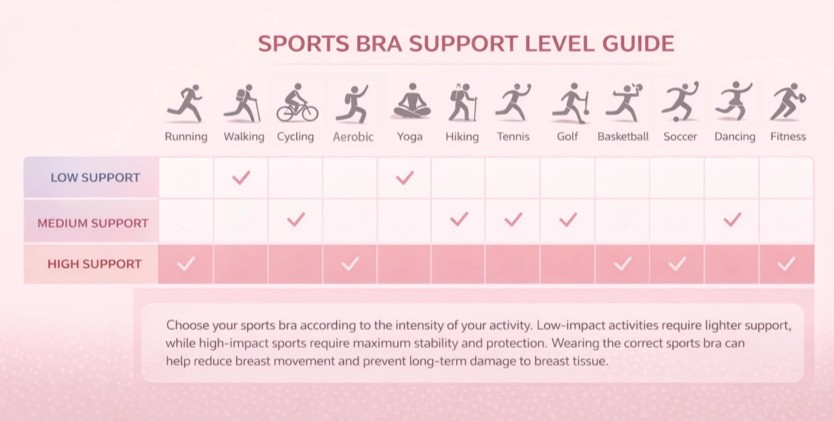
Modern sports bras are usually designed according to different levels of exercise intensity.
I also recommend choosing your sports bra based on the type of activity you do.
1. Low Impact Activities
These involve lighter movements and lower impact.
Examples include:
• Yoga
• Walking
• Hiking
⸻
2. Medium Impact Activities
These activities involve moderate movement and impact.
Examples include:
• Cycling
• Hiking / Climbing
• Golf
• Tennis
⸻
3. High Impact Activities
(This is the type I personally use most often.)
Examples include:
• Running
• Cycling during interval training
• Spinning
• Soccer
• Basketball
• TABATA training
• Aerobic dance
★ How to Choose the Right Sports Bra Size
1. The Fit Must Be Correct
Both the band and cup size must fit properly.
When choosing a sports bra, the size must fit your body well.
If the band fits but the cup area is too loose and cannot fully contain the breasts, or if it is too tight and compresses the chest excessively, then the sports bra is not suitable.
A bra that is too tight can make it difficult to breathe during exercise, while a bra that is too loose will not provide enough stability.
Make sure that your entire breast is fully covered by the bra, and that the tissue near the underarms does not spill out.
At the same time, check that the bra provides sufficient coverage and stability, and that the shoulder straps stay in place without slipping.
⸻
2. The Bra Must Provide Good Support
A sports bra should provide strong support to minimize breast movement, especially during high-impact activities.
When trying on a sports bra, you can move around in the fitting room — try walking, jogging, or jumping slightly.
If the bra can fully contain your breasts and prevent obvious bouncing, then it is likely a good fit.
Also check whether there are any uncomfortable areas, or places that feel too tight and may cause chafing during long periods of movement.
In general, wider shoulder straps and a wider underband provide better support, so this can be an important factor to consider when purchasing a sports bra.
⸻
3. Good Sweat-Wicking Ability Is Important
Personally, I usually do not wear only a sports bra when exercising — I also wear another top over it.
Therefore, if the sports bra does not have good moisture-wicking ability, it can feel extremely uncomfortable.
If sweat stays trapped inside the bra for too long, it may cause skin irritation, rashes, or even acne on the chest area.
For this reason, women should choose sports bras with good sweat-wicking and breathable fabrics.
A thoughtful feature of this design is the front-closure style, which makes it easier to put on and take off.
It also takes into consideration women with fuller busts, providing stronger support where it matters most.
⸻
4. Shoulder Straps Should Not Slip Easily
To maintain good stability, the shoulder straps should stay securely in place.
Generally speaking, wider shoulder straps provide better support and stability compared to thin straps.
When trying on a sports bra, make sure the straps fit comfortably on your shoulders and do not slip off easily.
A well-designed strap system helps keep the bra stable during movement and improves overall support.
⸻
5. Replace It When It No Longer Fits Properly
After repeated washing and long-term use, bras will naturally lose elasticity.
When the underband becomes loose, the shoulder straps stretch out, or the cups begin to lose their shape, the overall support of the bra will start to weaken.
When this happens, it is time to replace your sports bra with a new one that fits properly.
Wearing a worn-out sports bra will reduce support and may increase breast movement during exercise.
Leave a message
Please log in before leaving a comment。